MİR-D20
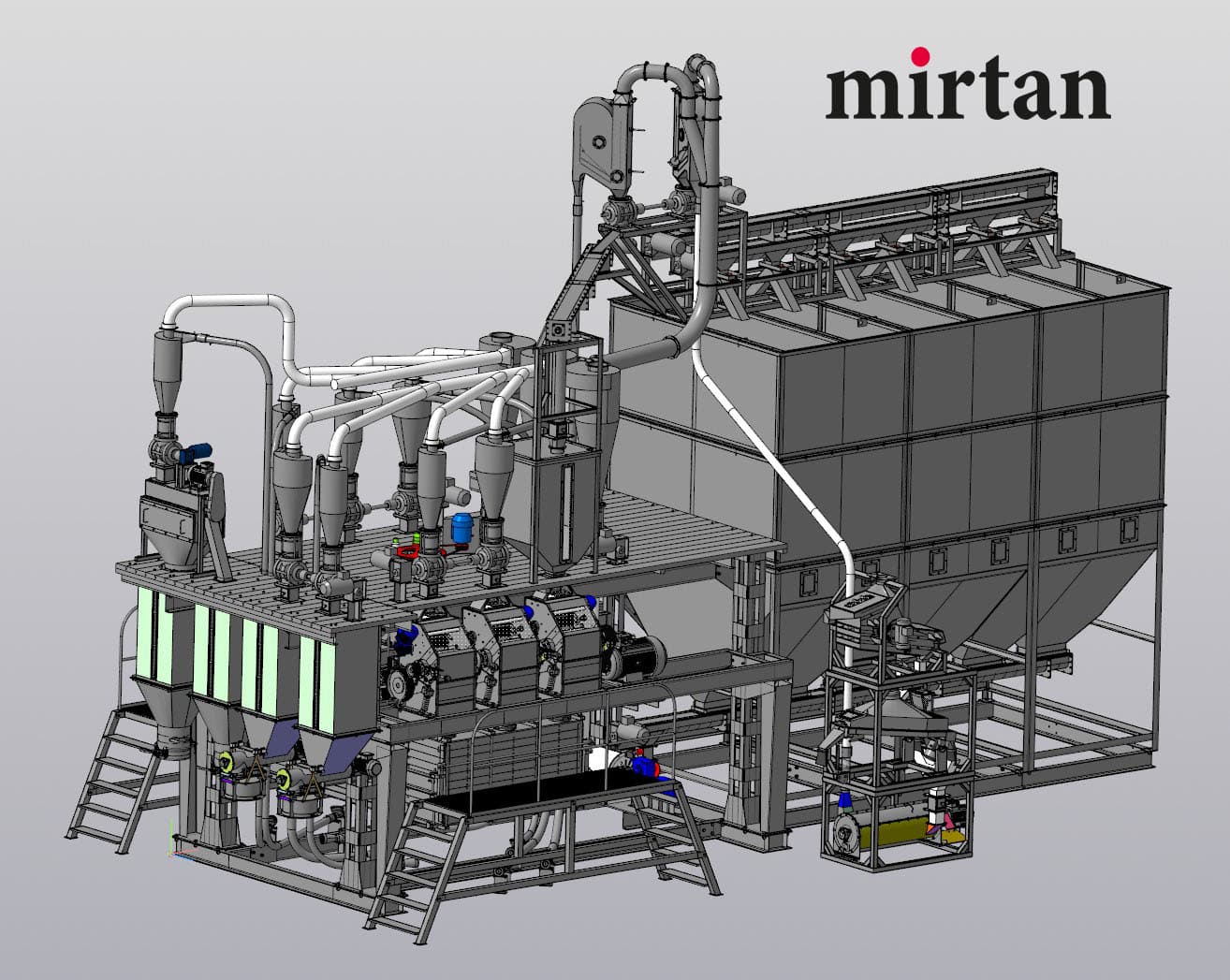
The complete mill MİR-D20 (farther “mill”) is designed for grinding basic wheat grain and producing baking flour. The basic version of the mill processes flour of three grades: premium, first and second. Semolina collection is not provided. Overall dimensions of the mill: length 9.1 m, width 5 m, height 7 m.
| Technical productivity of grain when grinding grain of basic standards | 20 tons per day |
|---|---|
| The total flour yield in the basic version, including: | 75% |
| Premium-class | 50-55% |
| First-class | 20-25% |
| Second-class | 5% |
| Roller line length | 1,92 m |
| Screening surface | 25,44 m² |
| Mains supply voltage | 380±38 V |
| Total power of installed electric motors | 56,72 kW |
| Service staff | 2 person |
| Warranty period | 13 months |
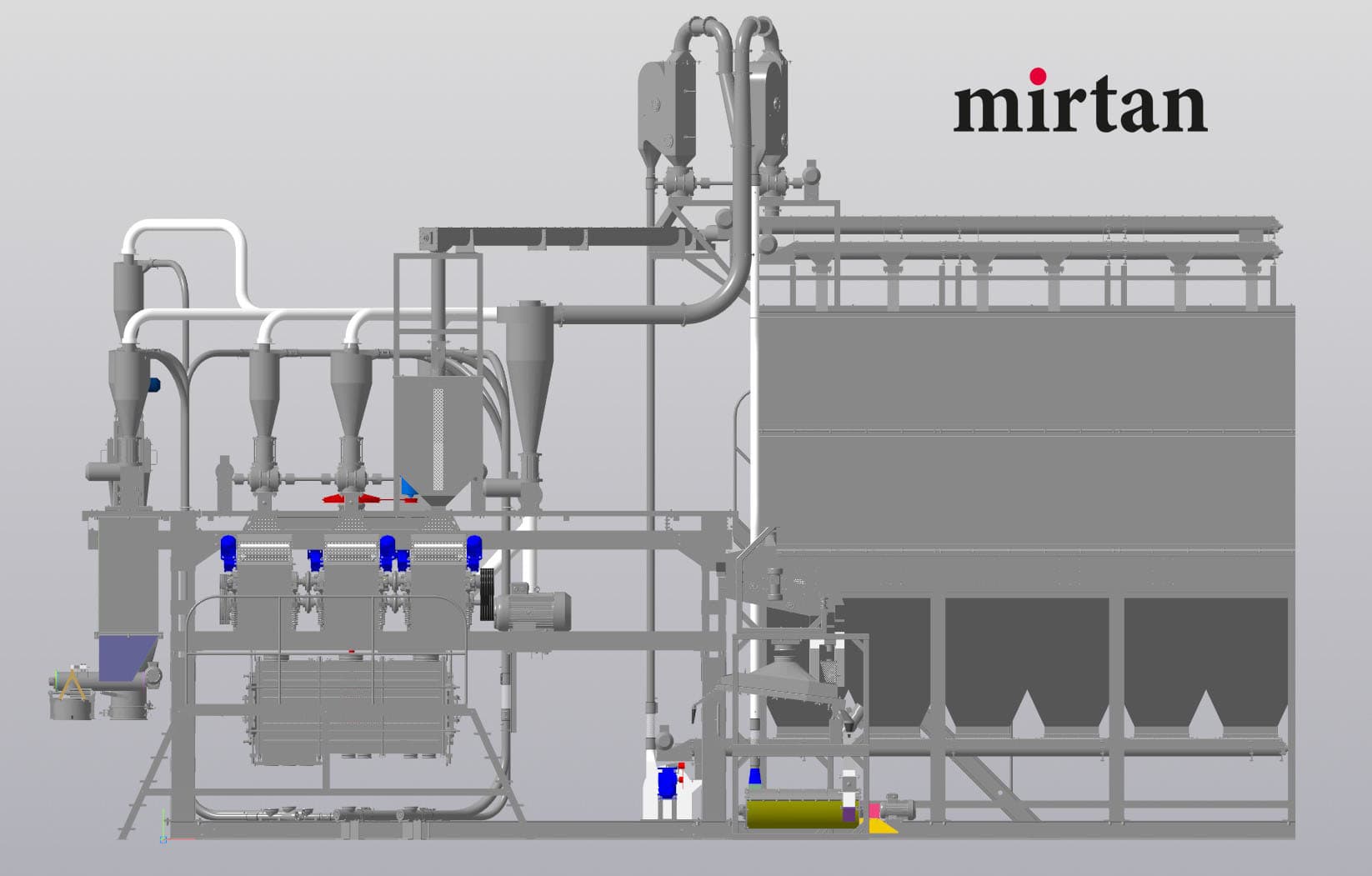
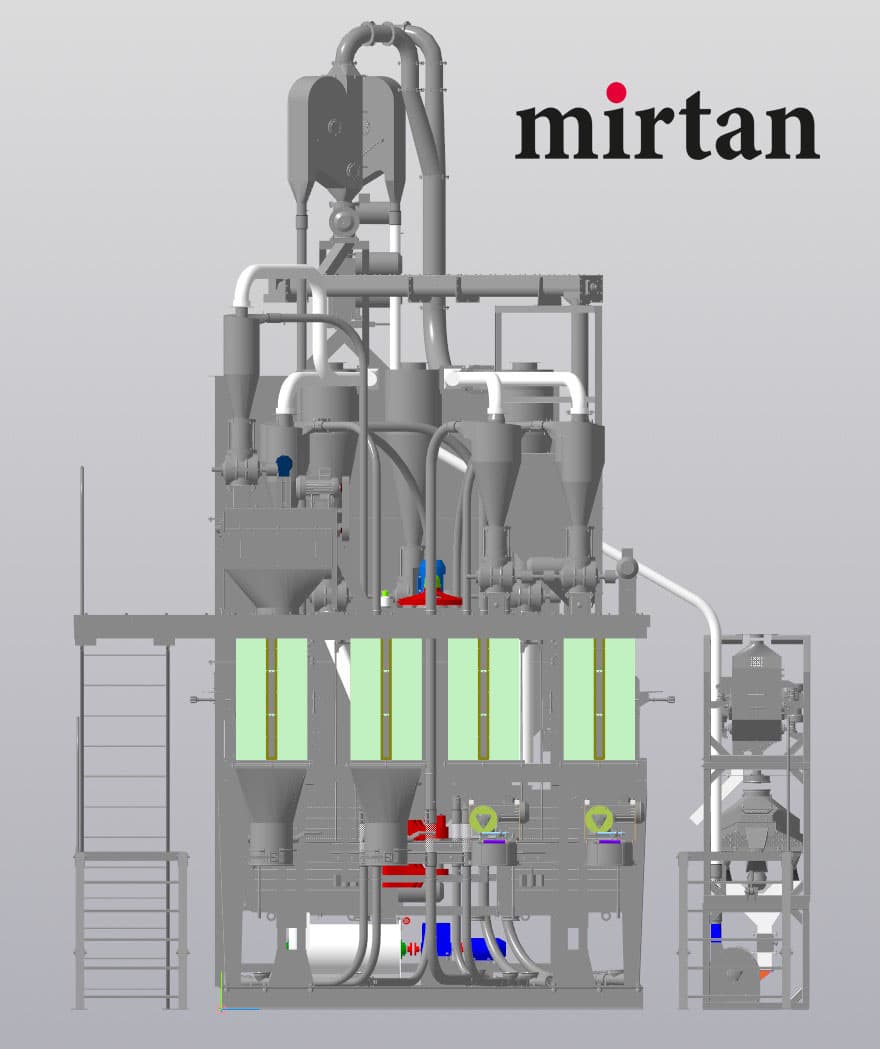
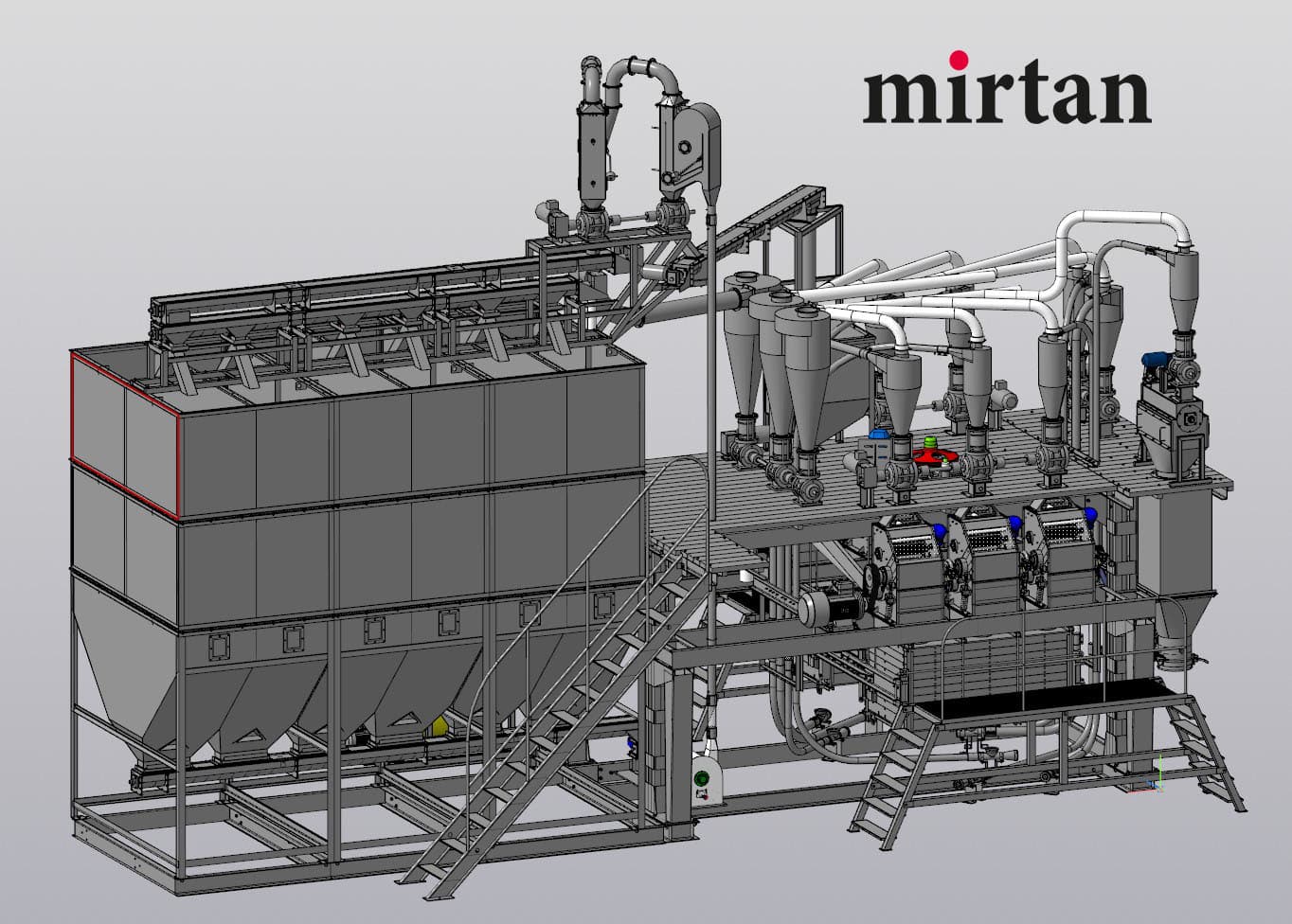
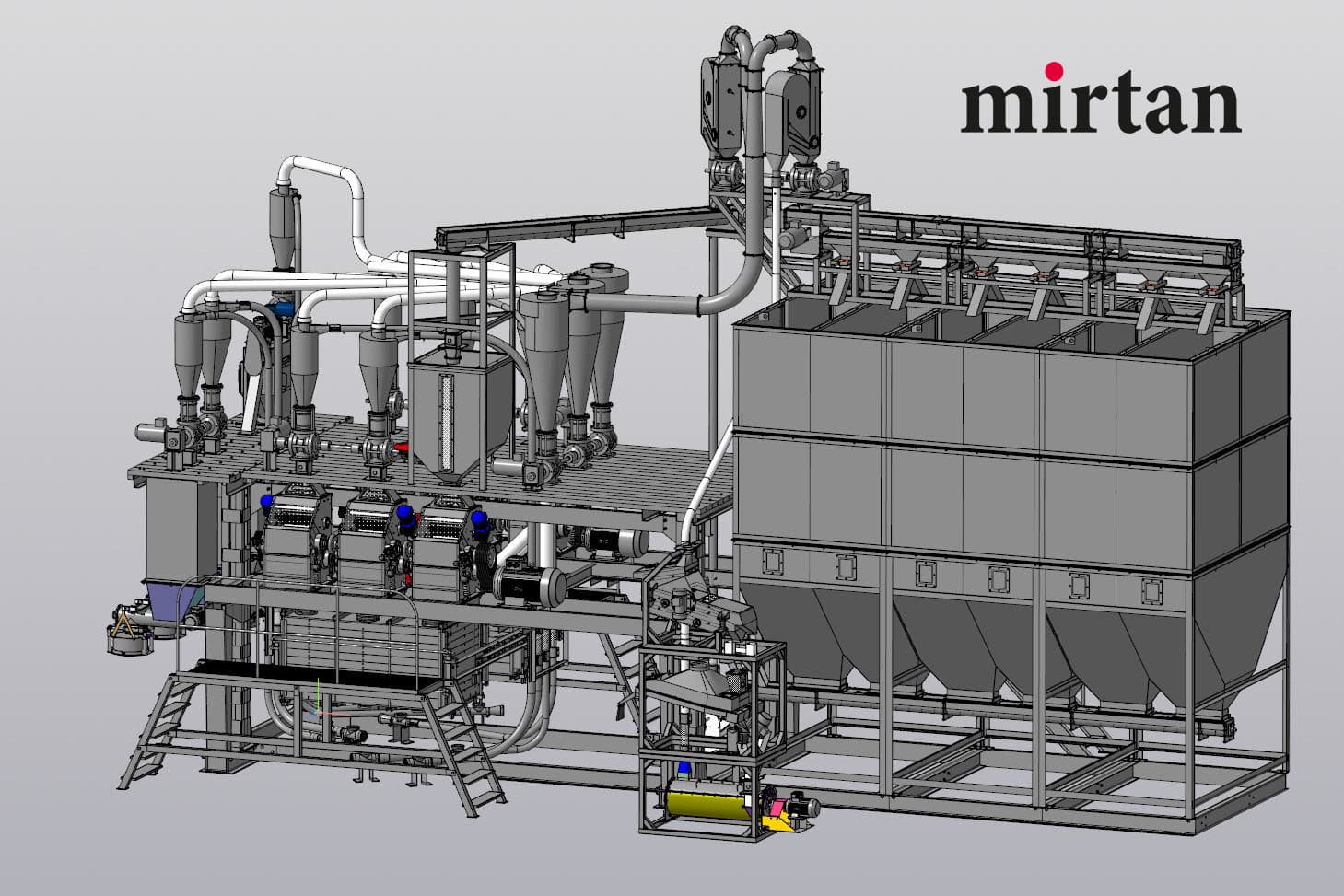
Additional information
The mill includes a set of equipment for preparing, grinding grain, dosing and beating out finished products, as well as the necessary electrical and auxiliary equipment. The movement of grain is carried out by mechanical and pneumatic transport, intermediate and final products and bran - by pneumatic transport.
The mill delivery set includes:
Grain preparation compartment
Grinding compartment
Weighing compartment
Control system
Set of spare parts and accessories
*At the request of the customer, the delivery set of the mill can be changed.
The principle of operation of the mill is sequential cleaning, double moistening and dampening of grain, grinding, sifting and separation into final products: premium, first, second grade flour and bran.
The grain is cleaned, moistened and dampened. Then the surface of the grain is refined, additionally moistened and cooled. The prepared grain is sent for grinding to the grinding department. Grain grinding is carried out in six roller machines with a roller length of 250 mm and a diameter of 250 mm. The overall yield in the basic version is 75%. Premium flour - 50-55%, 1с - 20-25% and 2с - 5% (depending on the raw materials). The grinding compartment is equipped with a package sieving machine with a technological diagram of the grinding grade ordered by the Customer. It is also possible to change the yield percentages for each variety at the request of the Customer, and according to the quality conditions of the original grain. Next, the final products are transported to the weighing department. Flour is dosed using weighing dispensers and packaged in fabric bags, 104+/-2cm long and 53+1cm wide. By default, a dose of 50 kg is put into bags. The value of the knocked-out dose can be changed by the settings of the weigher controllers.
The grain in the compartment undergoes the following sequence of operations:
reception of unrefined grain into the bunker;
supply of grain by elevator and gravity transport to the area;
cleaning grain in a sieve separator from impurities that differ from the main grain in size and aerodynamic properties;
cleaning grain in a drum trier from impurities that differ from the main grain in length;
cleaning the grain surface in cleaning machines;
humidification using intensive humidification machines;
Four containers are installed in the compartment, which provide 24-hour cooling during continuous operation of the mill. The deferred grain is again cleaned in a cleaning machine and aspirator, then re-moistened and sent for a second defoliation (within 20-30 minutes). The grain prepared in this way is sent to the grinding compartment.
The grain is received at the mill into a receiving hopper, from where it is fed into the grain cleaning machine by a elevator (a receiving compartment and elevator are not provided in the basic version). The finished grinding mixture is supplied to the receiving hopper. If the customer wishes, for an additional fee, it is possible to equip the mill with a receiving department with the ability to form grinding mixtures. The capacity of silos of this type can vary from 25 to 120 tons.
Grain cleaning compartments are a set of grain cleaning, preparatory, transport, aspiration and auxiliary equipment
The grain inside the compartment is moved by mechanical transport. Grain cleaning machines are connected to aspiration systems.
The grinding compartment is a set of grinding, sifting, transport and electrical equipment designed for processing grain into flour of the highest and first grades. Grain grinding is carried out in six roller machines with a roller length of 250 mm and a diameter of 250 mm. The overall yield in the basic version is 75%. Premium flour - 50-55%, 1с - 20-25% and 2с - 5% (depending on the raw materials). The grinding department is equipped with a batch sieving machine with a technological diagram of the grinding grade ordered by the Customer. It is also possible to change the yield percentages for each variety at the request of the Customer and according to the quality conditions of the original grain.
Intermediate products inside the compartment are transported by its own pneumatic transport system. Breakout containers are storage units with a capacity of 100 kg each. At the bottom of the flour bins there is an auger and a knockout pipe for a standard bag (50 kg). The knockout compartment is equipped with weighing dispensers for 1st and highest grade flour. Bran and second grade are packed into standard bags without weighing.
The weighing compartment is a set of equipment for collecting, dosing, packing finished products into bags and transporting the bags outside the work area. Dispensers dose first, highest and second grade flour.
The aspiration system is designed to maintain a dust concentration in machines, mechanisms and containers for storing grain and finished products that is not residual for the occurrence of fire and explosion conditions, as well as to create a vacuum inside the machines, mechanisms and containers in order to prevent dust from entering the production area.
The mill is equipped with an automatic control system (ACS). The automated control system is designed to control the switching on and off of compartments, units and transport devices, monitor the state of the technological chain of equipment and ensure mutual interlocking of machines, control and record the operating modes of individual units and units of the mill. The total power of installed engines is 47.22 kW.
Installation is carried out in the following sequence:
Marking the foundations of the compartments according to the layout of the mill
Marking and pouring the foundations of the grinding-sifting and weighing compartment with embedded elements. Installation of equipment is permitted after the foundation concrete has completely cured in accordance with building codes
Unpacking transport containers and preparing units and components for installation
Installation of the grain cleaning compartment
Installation of the grinding compartment
Installation of the weighing compartment
Installation of product pipelines of the weighing compartment
Installation of air ducts
Installation of pneumatic systems of the aspiration and ventilation unit
Installation of electrical equipment
Installation of communication lines of the controller network
Installation of the central control station
Checking the direction of rotation of electrical equipment
Running in the compartments at idle speed
Balancing sieves
Starting the mill under load
Balancing sieving under load
Technological adjustment under load
Conducting briefings with service personnel
Commissioning of the mill
The mill is installed at the consumer enterprise by the manufacturer or under the guidance of representatives of the manufacturer. Installation is carried out on a contractual basis in a class B-IIa building, as well as permission from the State Labor Safety Supervision authorities to carry out this work, subject to the availability of a project. Putting the mill into operation on its own without permission from the State Labor Safety Inspectorate is prohibited.
Persons who have permission to perform work at height and who have been instructed in the rules of installation and safety precautions during installation must be allowed to install the mill.
Installation must be carried out in accordance with the requirements of "Process equipment. General requirements for installation manufacturability."
The wear resistance of the rollers between recuts, provided that the technological process of grain grinding is followed, is at least 3 months. The depth of the bleached (working) layer of the rollers ensures their performance during the warranty period, taking into account recuts.